Instrumentation
Instrumentation
All instruments on the main OSU campus are scheduled using RELMS. The 400 MHz spectrometer at ATAMI is scheduled using the NMR calendar.
800 MHz NMR Spectrometer
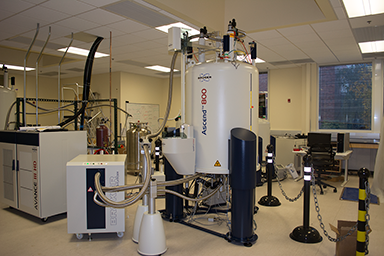
The 800 MHz NMR spectrometer is currently the highest field NMR spectrometer in the state of Oregon. The instrument is a 4-channel spectrometer equipped with a specially designed 5 mm TCI cryoprobe with Z-axis gradient, enabling improved sensitivity for 1H, 19F, 13C and 15N detected solution state experiments. In addition, the system incorporates a 24 well sample case for improved automation. This spectrometer will primarily be used for the analysis of biological samples, leading to advances in research areas such as Alzheimer’s Disease and Cancer. Instrument time on the 800 MHz spectrometer is allocated via request.
Cryoprobe Complete Specs
Location: LPSC 175
700 MHz NMR Spectrometer
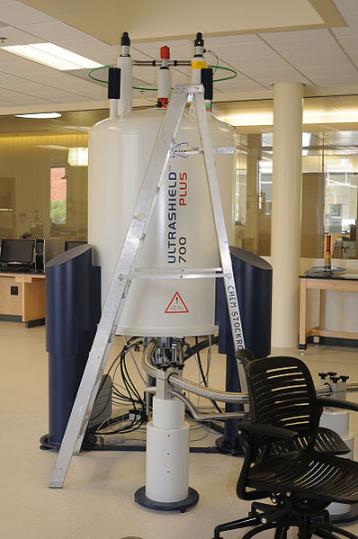
This spectrometer features high sensitivity for natural products and chemistry. The instrument is a 2-channel spectrometer equipped with a 5 mm carbon observe cryoprobe with Z-axis gradient, providing high sensitivity for solution state carbon experiments. The spectrometer is primarily used for the analysis and characterization of natural products and newly synthesized organic compounds. Also available for this spectrometer are BBO and BBI probes. This instrument is one of the most sensitive carbon-detecting spectrometers in the world - capable of measuring a high quality carbon spectrum on 1000+ molecular weight samples containing as little as 0.1 mg.
Scheduling Guidelines: Monday to Friday: 9 am to noon, 1.5 hour maximum reservation. Noon to 6 pm, 1 hour maximum reservation. No restrictions Saturday, Sunday and holidays. Longer runs may be possible during the days Monday to Friday, after consultation with NMR facility staff. Note: Nitrogen fills will be done 8:00 am to 9:30 am.
Location: LPSC 175
500 MHz NMR Spectrometer
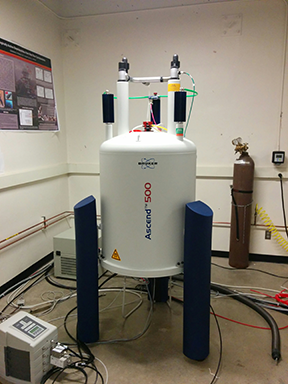
The 500 MHz instrument is a 4-channel spectrometer used for a wide range of solution state applications. A 5 mm BBOF probe and 5mm TXI triple resonance (HCN) probe, both equipped with Z-axis gradients, are available for this spectrometer. This spectrometer generally has the BBOF probe installed, but will occasionally have the TXI installed on an as needed basis. Please contact the NMR facility staff if you need the TXI probe. The sign next to the spectrometer computer indicates which probe is currently installed.
Scheduling Guidelines (when BBO is installed): No Restrictions
Scheduling Guidelines (when TXI is installed): No Restrictions
Note: Nitrogen fills will be done Fridays, 8:00 am to 9:00am.
Location: Gilbert Addition 101
400 MHz NMR Spectrometer (Robinson)
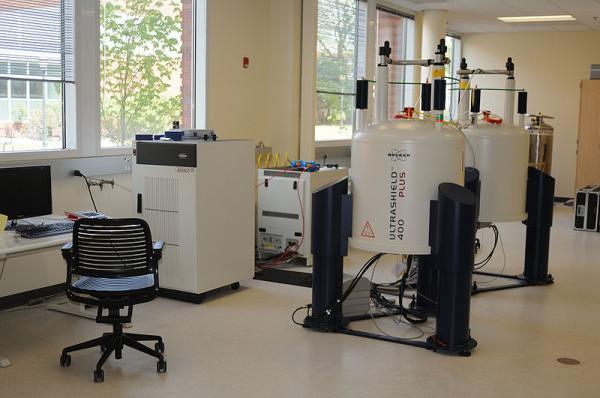
This instrument is a 3-channel Bruker Avance NEO NMR spectrometer used primarily for solid state analysis. The main probe is a Phoenix HFXY MAS probe with a 1.6mm probe head. We also have a 5mm BBOF solution state probe, with Z-axis gradients for this spectrometer. The spectrometer is normally equipped with the solid state probe, but may have the solution probe installed occasionally.
Scheduling Guidelines: Spectrometer time is allocated by request. Note: Nitrogen fills will be done on Thursdays at 10 am.
Location: LPSC
400 MHz NMR Spectrometer (Neo)
This 400 MHz NMR spectrometer was upgraded to a Bruker Avance NEO nanobay console. It is a 2 channel system and equipped with a BBO probe. We also have an InsightMR unit available for use on this spectrometer.
Scheduling Guidelines: No Restrictions
Location: ATAMI
Bruker ESR5000
Our Bruker ESR5000 EPR spectrometer is a benchtop, continuous-wave, X-band (9.4 GHz) instrument with a variety of attachments and modes. These include room temperature use and variable temperature (down to 100 K) with a liquid nitrogen variable temperature controller. EPR is frequently used in chemistry, to study metal centers, and organic and inorganic radicals involved in chemical processes. Furthermore, EPR has applications in materials science, and both life and pharmaceutical sciences. These applications range from testing the purity and stability of semiconductors, batteries, and active pharmaceutical ingredients, to investigating the structure and dynamics of proteins, RNA and DNA using spin-labeled biomacromolecules. To aid agriculture and food science, this spectrometer can analyze the oxidative stability and antioxidant capacity of foods and beverages. These broad applications are useful to users at OSU and beyond.
Scheduling Guidelines: No Restrictions
Location: Gilbert Addition 101
Analytical Ultracentrifuge
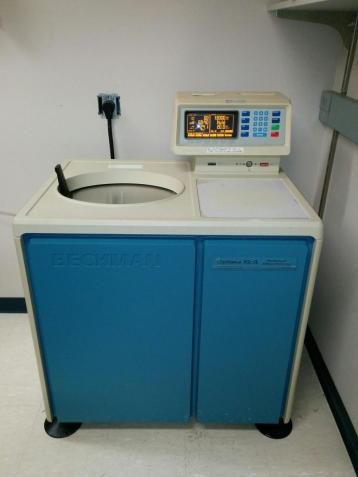
The facility also operates a Beckman Optima XL-A analytical Ultracentrifuge. This instrument is used to characterize particle sizes and behavior in solution. It is particularly valuable for the quantitative analysis of biomolecules, such as proteins and nucleic acids. It has broad applications in biophysics, such as determining protein homogeneity, polydispersity, association constants and equilibrium thermodynamic properties. In many cases, analysis with analytical ultracentrifugation is a desirable first step to characterizing a new protein sample, prior to NMR based structural analysis. Please contact Dr. Patrick Reardon for further information about accessing this instrument